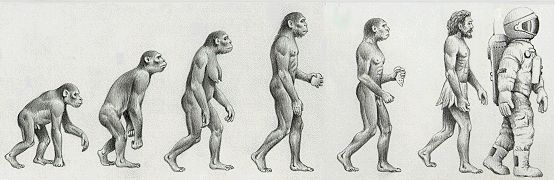
Naturalism is the philosophy and historical narrative most commonly heard about today. It is the one we are taught in school. In our religion or sociology classes we may learn interesting things about how Christians, Buddhists, Muslims, or Hindus view the world, but in our science classes we learn the real truth. The unadulterated truth. And we tend to believe it so sincerely that readers may not know whether the last two sentences were meant to be sarcastic.
I am using the term “naturalism” very broadly to include an entire family of philosophical views, between which there are shades of difference (such as materialism, positivism, scientific realism, etc). The purpose here is not a comprehensive analysis of any philosophy, much less a family of philosophies. Instead, my aim is thoughtful consideration of the single proposition that all of these philosophies have in common:
This core proposition of naturalism is that our natural world — space, time, energy, matter, and the laws that govern them — is the highest and lowest tier of existence. With these ingredients, and without any outside, divine help, we can both describe and explain our world. Nature itself, the world that we experience with our five senses and investigate with the scientific method, is ultimate. Matter is the first principle. Thus, the idea that anything supernatural might exist is a contradiction in terms. There is no need to invoke the existence of supernatural power, purpose, or design to explain the universe in all of its complexity and beauty as we see it: The big bang marks the beginning of our universe, and the chance formation of a single cell (or single strand of replicating RNA) leads, via evolution, to life in our present state.
Closely related to this central proposition of the ultimacy of matter is the view that our path to knowledge about the foundational truth of the universe is through the scientific process. In fact, a case could be made that the undeniable capacity of the of scientific process to lead to knowledge about the material world is what made naturalism a viable philosophy. In other words, men did not choose to believe in naturalism and then use science to discover what they could about the world. Rather, the scientific process and its ability to provide theories as explanations of natural phenomena over time led many to believe that the natural world is all there is. If we want knowledge, we need not bother ourselves with ancient books about gods or good or evil; we need only consult our senses and our reason. The predictability of the world implies an underlying natural law, which can, by the scientific process, be uncovered. Then we have Truth, in the most ultimate sense.
The dominant virtue of naturalism is that the reliability of science is reaffirmed and vindicated daily. The list of things that we don’t know or don’t understand keeps getting shorter. We can explain the motion of the planets, the entire process of digestion, down to the molecule, and the social structure of a beehive. We know why humans love pizza and sex. We know why we walk on two feet, why we love, why we gossip, why we are political. There is no need to invoke God or the Divine to explain the world, because all mystery and ignorance is constantly driven back by the light of knowledge.
With this knowledge, mankind is able to take hold of his own destiny. Whereas religion puts us in the chains of higher authority, naturalism frees mankind by giving it an objective view of itself from the outside. It says that religion, if helpful, is only a helpful fiction. By taking away the religious lens and seeing ourselves for what we are, we are finally able to shape our world and our future according to our desire for better life.
As we shape ourselves, our species, and this world, we are able to revel in our own glory. Humanity has been shaped and honed by a process spanning eons. And we have arisen, conscious, from this crucible, and found ourselves its master. Now we can take the reins and pull ourselves to new heights, if we dare. The cold curtain of time will inevitably close upon us, but today the blossom of our life is stark and beautiful against the void.
The narrative of naturalism is bold, brave, and undeniably life-affirming. The future is coming and the future is progress. It must be. That is our only option. The future concerns all of us, and it requires the best of us. We are its makers. So the naturalist looks ever forward, and abhors any hint of stagnation or, God forbid, regression.
This may sound over-spirited. And, of course, I do not speak for all naturalists. No one could. But meditating on the foundational premise of naturalism, that we are the beautiful product of a violent and chaotic process in a material world, it is difficult to avoid a spirited fanaticism of the present and eager anticipation for the future. We are the best we’ve ever been, and we’re getting better. Why shouldn’t we all get on board for progress?
Yet, as with each of the worldviews we will cover here, the premise of the natural (material) world as ultimate reality does not leave us without a few difficulties in comprehending ourselves and our lives. Next, I will review a few potential objections to the naturalist view.
 bonesofbelief